Content on this page may include affiliate links. If you click and sign up/place a wager, we may receive compensation at no cost to you.
Where are Online Casinos Legal in the US? A 2026 State-by-State Guide (October 2026)
Find out where you can and can't legally play online casino games in the USA. Also, see which states are getting closer to legalizing and regulating online casinos.
The United States is experiencing a rapid growth of online casino gaming, but its legal status is still determined by the state a player is located in. Unlike the widespread sports betting market, legal online casinos in the U.S. are restricted to a select number of online casino legal states.
This guide highlights all of the states that allow legal online casino apps, which ones are considering legislation to legalize them, and updates on the status of legal online casinos in every U.S. state and provides essential information on U.S. iGaming laws in general.
How online casino legality is determined in the US
The legality of online casinos in the USA is determined by a mix of federal and state laws. The federal government establishes boundaries on interstate online gambling, while states ultimately decide the legal status of iGaming within their borders.
In short, there's no nationwide law that legalizes or bans gaming sites across the US. With states having the right to determine legal gambling and online casino regulations, the landscape is fragmented. You can enjoy legal online casino games in one state, only to cross over into a neighboring jurisdiction and find iGaming prohibited.
Federal vs. state authority: The Wire Act and UIGEA explained
Two laws determine the interstate legalities of gaming sites, including the Wire Act and the Unlawful Internet Gambling Enforcement Act (UIGEA). Here's a quick look at how these federal online gambling laws work and impact states
Wire Act
This law was passed in 1961 to combat organized crime by restricting their interstate gambling communications. It was also meant to stop illegal sports betting operations from spreading across the country.
Today, the Wire Act has the broader effect of keeping legal online casinos in the USA confined to individual states. Gaming sites must treat each state separately from an operational standpoint. They can't pool players across multiple states to create larger progressive jackpots.
UIGEA
Attached to the SAFE Port Act of 2006, the UIGEA strictly concerns financial transactions related to online gambling. It prohibits financial institutions and payment processors from facilitating transactions associated with unlawful gambling activities.
Payment facilitators are free to work with legal online casinos in the USA. However, they're considered in violation of federal and/or state laws when working with unregulated offshore casinos and sportsbooks.
Why does online casino legalization take place state by state?
The main reasons why online casinos are legalized on a state-by-state basis include:
States have the right to decide if online casino play is legal within their borders.
The absence of a federal law that legalizes or prohibits gaming sites.
States choose to legalize online gaming based on a mix of factors, like tax revenue goals, casino industry expansion, and competition among neighboring online casino legal states
Many jurisdictions also want to discourage online gamblers from using unsafe and unlawful offshore sites by providing legal alternatives.
How regulators license and audit online casino operators
Regulators in legal iGaming states require operators to meet certain qualifications before granting a license. While standards can vary from state to state, legal online casinos in the USA must typically have:
- A partnership with an in-state retail casino
- Detailed financial records
- Executives and other key personnel who pass background checks
- Anti-money laundering measures & other compliance systems
- Adequate responsible gambling resources
- Secure website, app, and payment processes
- Ability to pay licensing fees and taxes
Licensing is only the beginning for an online casino to become legal. Regulatory bodies routinely audit operators through system testing, compliance reviews, mandatory reports, and investigations.
An online casino in legal states will have no trouble with audits if it complies with regulations. However, those who don't can face fines and license suspension in the worst-case scenarios.
Legal online casino status of all 50 states (2026)
Here is where each state stands on legal online casinos, as of October 10, 2026.
State | Status | Regulatory Authority |
Alabama | Not legal | Not applicable |
Alaska | Not legal | Not applicable |
Arizona | Not legal | Not applicable |
Arkansas | Not legal | Not applicable |
California | Not legal | Not applicable |
Colorado | Not legal | Not applicable |
Connecticut | Legal | CT Department of Consumer Protection (Gaming Division) |
Delaware | Legal | Delaware Lottery (Division of Gaming Enforcement) |
Florida | Not legal | Not applicable |
Georgia | Not legal | Not applicable |
Hawaii | Not legal | Not applicable |
Idaho | Not legal | Not applicable |
Illinois | Not legal | Not applicable |
Indiana | Not legal | Not applicable |
Iowa | Not legal | Not applicable |
Kansas | Not legal | Not applicable |
Kentucky | Not legal | Not applicable |
Louisiana | Not legal | Not applicable |
Maine | Expected launch in 2026 | Maine Gambling Control Unit |
Maryland | Not legal | Not applicable |
U.S. legal online casinos map 2026
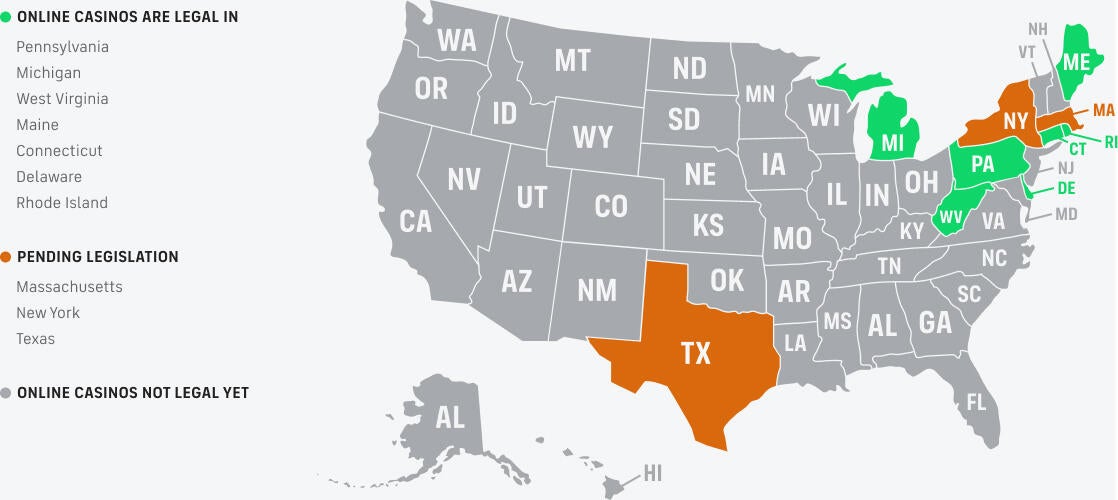
The eight US states where online casinos are legal in 2026
The states with legal online casinos currently include Delaware, Maine, Michigan, New Jersey, Pennsylvania, Rhode Island, and West Virginia. Nevada is another of the states where online gambling is legal, but only for iPoker, not casinos. We'll stick with discussing the eight legal online casino states below.
New Jersey
When it became legal: Signed in February 2013 and launched in November 2013. NJ is the largest and most established US iGaming market, serving as the model other states reference.
Legal regulatory authority: Regulated by the New Jersey Division of Gaming Enforcement (DGE), which licenses operators, audits games, and publishes monthly revenue reports. Operators must partner with an existing Atlantic City casino to obtain a license.
Licensed operators and game variety: More than 25 licensed iCasino operators, including BetMGM, DraftKings, FanDuel, Caesars Palace, Borgata Online, BetRivers, bet365, Hard Rock, Bally's, Golden Nugget, Fanatics, PlayStar, PartyCasino, ResortsCasino, and more. NJ has the broadest game catalog of any US iGaming market, including thousands of slots, a full table game variety, and large live dealer studios.
State programs funded by tax revenue: Most of the NJ iGaming taxes feed the Casino Revenue Fund, which supports people with disabilities, property/rent/utility cost reductions, expanded health services, pharmaceutical services, and community senior programs. A smaller portion of funds the Casino Reinvestment Development Authority (CRDA) for Atlantic City.
Overall state revenues: iGaming tax rate is 22.25%, with 19.75% going to the state and 2.5% reserved for the reinvestment development authority. NJ has collected over $1.5 billion in iGaming tax revenue since 2018. Total state gaming taxes/fees in FY 2025 reached $1.1b, with $667.1m directed to the Casino Revenue Fund.
Latest New Jersey online casino news
The Garden State continues to post record-breaking revenue figures, with iGaming surpassing brick-and-mortar casino revenue in 2025. NJ online casinos earned $276.9 million in July 2026, which topped the $271 million reported in June. It also represented a 12.0% increase over the July 2025 figures. It's worth noting that the June revenue stats signaled a 17.5% increase over the same period in 2025, and it was the first time NJ online casinos outpaced land-based Atlantic City casinos.
Read more about NJ online casinos here.
Pennsylvania
When it became legal: Legalized in 2017 as part of a broader gaming expansion package. Legal online casino sites went live in 2019 and quickly experienced success.
Legal regulatory authority: The Pennsylvania Gaming Control Board (PGCB) issues licenses, ensures compliance from operators, conducts audits, and enforces responsible gambling.
Licensed operators and game variety: The Keystone State features over 20 online casino brands, such as BetMGM, BetRivers, Caesars Palace, DraftKings, FanDuel, Fanatics, Golden Nugget, and the homegrown betPARX. It's a serious rival to New Jersey in terms of sheer casino game volume, offering thousands of slots, dozens of table game variations, and many specialty games.
State programs funded by tax revenue: Tax funds from PA iGaming generally go to property tax relief for homeowners. Other areas that receive funds include the State General Fund, economic development, and responsible gambling services.
Overall state revenues: Pennsylvania leads online casino legal states in tax revenue. It has collected over $4 billion from iGaming alone since its iCasinos launched in 2019, highlighted by a record-breaking $1.1b in the 2024-25 fiscal year. Its lofty 54% iGaming tax rate is the key catalyst behind these numbers. The tax revenue in June 2026 was $111,305,492.
Latest Pennsylvania online casino news
The Monopoly Casino promo code recently went live in Pennsylvania and New Jersey, granting players a substantial welcome bonus as well as the opportunity to play plenty of exclusive Monopoly titles.
Read more about PA online casinos here.
Michigan
When it became legal: Signed into law in 2019, with iGaming launching in 2021. The Michigan online casino market is currently growing at a rapid pace.
Legal regulatory authority: The Michigan Gaming Control Board (MGCB) regulates all legal online casino activity in the state. It handles licensing, game and financial audits, cybersecurity standards, and enforcing responsible gambling measures.
Licensed operators and game variety: The Wolverine State currently has over a dozen regulated casino apps, such as BetMGM, DraftKings, Four Winds Online, Hard Rock Bet, and Play Gun Lake. Operators must find a commercial casino partner in Detroit or a tribal casino partner to get a license. Michigan's game variety is competitive with top legal online gambling states since it offers thousands of online slots and hundreds of other games.
State programs funded by tax revenue: Most iGaming tax revenue goes to the state's School Aid Fund and the Internet Gaming Fund. The remaining amount goes to the City of Detroit, agricultural development, and horse breeding programs.
Overall state revenues: Michigan has an adjustable online casino tax rate that ranges from 20% to 28%, depending on operator revenue. It has generated just over $3 billion in tax revenue since going live in 2021.
Latest Michigan online casino news
Michigan's iGaming market continues growing and adding new operators. It also routinely sets monthly online gaming revenue records. In August 2026, the state reported earning of $303 million, which is in the same neighborhood as July ($302.7 million) and June ($301.2 million). It also represented the sixth straight month of online casinos in Michigan eclipsing the $300 barrier.
Read more about every online casino Michigan offers here.
West Virginia
When it became legal: The Mountaineer State officially joined the legal online gambling states by passing the West Virginia Lottery Interactive Wagering Act. Its gaming sites went live in 2020, making it one of the earliest iGaming markets outside of New Jersey and Pennsylvania.
Legal regulatory authority: The West Virginia Lottery Commission regulates all online casino activity in the state, including licensing, responsible gambling oversight, and geolocation enforcement. As with most legal online casinos in the USA, all WV gaming sites must have a local retail casino partner.
Licensed operators and game variety: There are currently 10 licensed iCasinos in West Virginia, such as BetMGM, BetRivers, Golden Nugget, Fanatics, and Hollywood Casino. With just over 1.7 million residents, West Virginia doesn't have quite as many games as other regulated states yet. Nevertheless, a few casinos do offer over 1,000 total games.
State programs funded by tax revenue: Online casino tax money goes to the West Virginia State Lottery Fund, where it's then funneled into senior services, education, scholarship funds, tourism, and the State Park Improvement Fund.
Overall state revenues: The Mountaineer State taxes iGaming operators at 15%. It collected a record $56.1 million in online casino tax revenue in 2025.
Latest West Virginia online casino news
West Virginia is seeing a rapid increase in tax revenues in 2025, earning almost double the $29.7 million it generated in 2024. It has also been hitting iGaming revenue records, including bringing in a shade under $39 million in June 2026, following $39.54 million in revenue in May. For the year, West Virginia has generated over $203 million from online casino games.
Read more about WV online casinos here.
Maine
When it became legal: Maine became the eighth and newest state to enter the online casino USA legal market in 2026. It has yet to launch its online casinos, but each of the state's four Wabanaki Nations Tribes is expected to run a gaming site with a commercial partner. While some reports indicated a launch happening in late 2026, it's more likely expected in early 2027.
Legal regulatory authority: The Maine Gambling Control Unit (GCU) will oversee licensing, regulations, audits, and compliance for the market.
State programs funded by taxes: Tax revenue from legal online casinos is expected to support tribal communities, education, housing, and veterans' programs.
Overall state revenues: Although not finalized, the Maine iGaming tax rate is expected to be between 16% and 18%. It remains to be seen what kind of tax revenue the Pine Tree State will generate from gaming sites.
Latest Maine online casinos news
- The next Gambling Control Unit meeting is scheduled to take place on October 20 in Augusta, Maine.
- The Gambling Control Unit held a meeting on August 18, at the Oxford Casino, in Oxford, Maine.
- The Gambling Control Unit held a meeting on June 16 at Hollywood Casino in Bangor, Maine.
- The Oxford Casino & Hotel is suing GCU Director Milton Champion over giving the Wabanaki Nations Tribes exclusive rights to the state's iGaming market.
Read more about Maine online casinos here.
Connecticut
When it became legal: The Nutmeg State legalized online gaming in 2021 after working out an agreement with its two tribal casino operators, Foxwoods and Mohegan Sun. Legal gambling at online casinos started later that same year.
Legal regulatory authority: The Connecticut Department of Consumer Protection regulates online casinos in the state and oversees compliance and responsible gambling measures. Unlike most states where online gambling is legal, this one only has a limited market with two operators. These include DraftKings (partnered with Mohegan Sun) and FanDuel (Foxwoods).
State programs funded by tax revenue: Taxes generated from Connecticut iGaming initially go to the state's General Fund, then into programs for education, emergency services, policing, and infrastructure projects.
Overall state revenues: Connecticut's tax rate on iGaming operators recently rose to 20%. Online casino tax revenue hit a record $139.1 million in 2025.
Latest Connecticut online casino news
Connecticut lawmakers have been heavily discussing a crackdown on sweepstakes casino sites. Unlike legal online casinos in USA states, sweepstakes operators don't have licensing or specific regulations to follow.
Delaware
When it became legal: Delaware was the first state in the USA to legalize online casinos, doing so in 2012. It also became the first to launch regulated gaming sites, with operators going live in 2013.
Legal regulatory authority: The Delaware Lottery regulates iGaming in partnership with the state's three racinos, including Bally's Dover, Delaware Park, and Harrington Raceway. The Blue Hen State is unique among online casino legal states because it allows very limited commercial participation. BetRivers is the lone commercial brand permitted to work with the racetracks.
State programs funded by tax revenue: Most of the Delaware iGaming tax income is split between the three racinos (paid by BetRivers) and the State General Fund. The remaining amount goes to horse racing purses and maintaining land-based slot machines and table games.
Overall state revenues: Delaware has two tax rates for its single commercial operator, including a lofty 57% for "internet video lottery" games (a.k.a., slots) and 15.5% for table games, plus an extra 4.5% "purse supplement." Minus the racetracks' cut, the state collected a record $41.7 million in 2025 iGaming taxes.
Latest Delaware online casino news
The Blue Hen State reported $85 million in iGaming revenue in fiscal year 2025, which more than doubled the $31.9 million generated in 2024. Plus, it has joined other jurisdictions looking to protect their online casino legal USA markets from sweepstakes competition. It issued cease-and-desist orders to VGW Luckyland, accusing it of offering illegal gambling.
Rhode Island
When it became legal: Rhode Island is one of the newest states to offer legal online casinos in the United States. It legalized iGaming in 2023 and saw its operation go live in 2024.
Legal regulatory authority: The Rhode Island Lottery oversees iGaming regulation in the state and works exclusively with the Bally's Corporation. This is the only state besides Delaware to use a single commercial operator.
- State programs funded by tax revenue: Taxes earned through online gaming go to the state's General Fund and budget initiatives.
Overall state revenues: The Ocean State taxes online slots revenue at 61% and table games at 15.5%, plus an additional 4.5% purse supplement. It earned $29.3 million in online casino tax revenue in 2025, the lowest among states with legal online gambling on casino games.
Latest Rhode Island online casino news
Bally is staying put as the sole commercial iGaming operator in Rhode Island. However, it did recently complete a $700 million leaseback sale for its Twin River Lincoln Casino property.
States to watch: where online casino legalization could happen next
Many states are currently trying to answer the question: Is online casino gaming legal? Here are three states that may be closer to answering yes than other unregulated jurisdictions.
Massachusetts
The Bay State has all the elements in place for an eventual online casino market, including an established gaming commission, commercial casinos, and legal online betting.
Not surprisingly, multiple bills have been introduced to regulate iGaming. A 2026 legislative effort died in a committee study amid concerns over consumer protections and competition with land-based casinos. Even so, Massachusetts will likely get around to adding online casinos to its legal gambling offerings.
Likelihood: Moderate to high over the next 3-5 years, especially if the state faces tax revenue pressures.
New York
The Empire State stands to gain more than most potential legal online casino markets in the USA. It has a massive population and tax base, plus a strong need for additional tax revenue.
Online sports betting has already brought in more than $1 billion in tax revenue. It's not hard to see online casinos being a similarly successful driver of funds in New York, a heavily populated state that has sparse brick-and-mortar options.
As with Massachusetts, opponents express fears over increased addiction and competition for brick-and-mortar casinos. But these concerns could eventually be drowned out as lawmakers look for another tax source.
The latest legislative effort, S2614, recently died after it was clear the bill would get no support from Gov. Kathy Hochul.
Likelihood: High as revenue pressures increase on the state, although the timeline is murky and could be another 5-7 years.
Texas
On paper, Texas looks like a poor candidate for legal online casinos because it has such strict gambling laws. It has yet to answer yes to the question of whether online gambling is legal in any form.
However, that hasn't stopped lobbying groups from constantly pressuring Austin to legalize either online betting or casinos. Las Vegas Sands owner Miriam Adelson's presence in the state has only increased efforts to bring land-based and online gaming to Texas.
Likelihood: Low to medium for now, but lobbying pressures remain constant and could quickly accelerate matters.
States close to legislation
Nearly a dozen states have either introduced, debated, or considered online casino legislation. Contrast this to the dozens of states with no plans to bring legal online casinos to the USA. Let's look at each state that's at least discussing regulating iGaming.
Arkansas
• Current status: Mobile sports betting is legal but restricted to three in-state operators tied to Arkansas' licensed casinos. No iCasino legislation has seriously advanced in either house.
• Key obstacle: Existing in-state casino operators are resistant to expanding online; the limited-licence sports betting model also constrains how iGaming might launch.
• Outlook: Near-term legalization unlikely without a shift in the casino industry's stance.
Florida
• Current status: Florida allows legal online sports betting exclusively through the Seminole Tribe's Hard Rock Bet app. Online casino gaming hasn't received any serious consideration in the legislature.
• Key obstacle: The Seminole Tribe enjoys a lucrative gaming compact with the state and isn't ready to change the status quo. They appear content with their land-based casino empire and FL mobile betting monopoly.
• Outlook: Any attempt to bring legal online casinos to Florida will likely require approval from the Seminoles, which isn't happening any time soon.
Hawaii
• Current status: Along with Utah, Hawaii is the only state that bans all forms of gambling. Several lawmakers have introduced bills to legalize sports betting and gaming, but with no luck.
• Key obstacle: Hawaii's political and cultural resistance to gambling remains the biggest roadblock.
• Outlook: While the Aloha State is having more frequent discussions on regulating gambling, it doesn't appear anywhere close to approving online casinos.
Indiana
• Current status: The Hoosier State has one of the best chances of legalizing and bringing more legal online casinos to the USA. It has a mature retail casino industry and mobile sports betting, so iGaming seems like a natural fit.
• Key obstacle: Several legislative attempts have been made to legalize IN online casinos. Things always fall apart over disagreements regarding tax structure and cannibalization concerns from land-based operators. However, the interest in legalizing iCasino is there, making it likely that the other issues can be put aside in the future.
• Outlook: Indiana could realistically legalize online casinos in 2-5 years if all sides can come together.
Iowa
• Current status: The Hawkeye State has shown mild interest in iGaming after experiencing success with mobile betting, but no related bills have advanced past committees.
• Key obstacle: Concerns over responsible gambling measures and the impact on smaller regional casinos have held Iowa online casino discussions back.
• Outlook: Iowa will likely regulate online gaming, but it may wait until neighbors do so first since the pressure isn't there yet.
Louisiana
• Current status: Louisiana seems like a good candidate to legalize online casinos at some point, with its large retail casino industry and strong betting market. However, it hasn't had any bills gain serious traction.
• Key obstacle: Changes to gambling laws require parish-by-parish approval, which complicates legalization efforts. Like with sports betting, some parishes might vote down iGaming, meaning it could be prohibited in certain parts of the state.
• Outlook: Online casinos will come to Louisiana at some point, but it might be 5-7 years due to the unusual parish setup.
Maryland
• Current status: The Old Line State is one of the most active in discussing and proposing online casino legalization. Several bills have been introduced, although none have gained serious momentum.
• Key obstacle: Critics worry that legal MD online casinos could reduce employment and in-person visits at retail establishments.
• Outlook: The issue of regulating iGaming isn't going away here. Expect legal online casinos within the next 4-6 years.
North Carolina
• Current status: North Carolina is fairly new to the legal online gambling landscape, launching mobile sportsbooks in 2024. It hasn't gotten around to any serious iGaming regulation efforts since then.
• Key obstacle: Most states don't immediately jump into the "is online casino legal" conversation after regulating sports betting. The Tar Heel State could be a few years away from this point.
• Outlook: North Carolina isn't in any hurry to legalize gaming sites, so I'm predicting a 7-10 year timeline on regulation.
Ohio
• Current status: The Buckeye State has one of the most successful mobile sports betting markets. Online casinos seem like they'd be on the horizon, but no meaningful iGaming bills have gone through either house.
• Key obstacle: Certain casino figures have provided iGaming resistance, while the usual concerns over market saturation and responsible gambling are present.
• Outlook: It could be at least 5 years before Ohio legalizes online casinos, but it will happen eventually—especially with three neighboring states offering casino apps.
Virginia
• Current status: Virginia has been one of the fastest-growing gambling states since legalizing sports betting and retail casinos in 2020. But expansion has cooled off, and no serious online casino regulation efforts have happened.
• Key obstacle: Some lawmakers are concerned with the fast pace of gambling expansion, while the usual fears surrounding problem gambling persist too.
• Outlook: Virginia looks like a solid online casino market, but iGaming legalization probably won't become a serious topic for another 2-4 years.
Wyoming
• Current status: The Cowboy State is unique because it only allows mobile wagering—no retail sportsbooks. Its focus on digital gambling opens the possibility for legal iCasinos.
• Key obstacle: The nation's least-populated state isn't overly attractive for major iGaming operators. There's little urgency in lobbying for online gaming in Cheyenne.
• Outlook: Wyoming may eventually add online casinos as part of its gambling landscape, but the lack of financial incentives means there's little hurry.
Frequently asked questions about online casino legality in the US
How many US states have legal online casinos in 2026?
Eight states currently offer legal online casinos, including Connecticut, Delaware, Maine, Michigan, New Jersey, Pennsylvania, Rhode Island, and West Virginia. Around a dozen states are discussing offering legal online casinos in the USA, such as Indiana, Maryland, and New York.
Is it legal to play online casinos in my state?
Online casino legality depends on your state's laws and regulations. Some states have legalized iGaming and are currently offering regulated casino apps. Others prohibit them and haven't even begun to discuss the question: Is online casino gaming legal?
Even if gaming sites are accessible where you live, they might not be legal and licensed. Check your jurisdiction's laws before attempting to register and deposit money.
Can I cross state lines to play at a legal online casino?
Yes, you can cross over into another state with regulated iGaming and play at legal online casinos. Being a resident is generally not a requirement to play for real money. However, you must ensure that you're actually within the relevant state's borders. Regulated online casinos use geolocation software to determine your location.
Are online sweepstakes casinos legal in my state?
Each state has a different stance on the legality of sweepstakes casinos. Some consider them legal USA online casinos according to the US Postal Service's guidelines on valid sweepstakes operators. Others view sweepstakes gaming sites as too close to real money gambling and now prohibit them.
The best approach is to check your local laws on what is legal online gambling in your state.
Are online casino winnings taxed differently across states?
Yes, online casino winnings are taxed differently in each state. New Jersey taxes iGaming winnings at up to 10.75%, for example, while Pennsylvania has a flat 3.07% rate. Meanwhile, the federal government treats online gambling winnings as ordinary income, taxable from 10% to 37%.
Why is online casino gambling legal in some states but not others?
There's no nationwide law covering legal online casinos in the USA. Each state has the right to treat online gambling how it sees fit. Some states have fully legalized online casinos, while others prohibit iGaming or treat it as a legal gray area.
Factors like political priorities, tribal compacts, tax revenues, and moral values all affect a state's online casino legal status.
What is the difference between online casino and online sports betting legality?
Online sports betting and online casino legality are normally regulated separately in each state. A state may offer legal mobile wagering but still prohibit online casino games like slots and roulette. Online sports gambling has expanded across states faster than iGaming.
When will my state legalize online casinos?
There is no set timeline for when a state will legalize online gaming. Some are actively discussing online casino legalization and even proposing bills, like in Massachusetts and New York. Others have little political push to regulate online casinos in the foreseeable future.
How do I know if a casino site is licensed and legitimate?
Legit online casinos are licensed by a valid state gaming authority. They should clearly display any relevant licensing info on their websites. Regulated gaming sites offer fully audited online casino games, trusted payment processors, identity verification, and responsible gambling tools.
You should avoid offshore casino sites because they're not regulated or safe.
Where can I find responsible gambling resources?
Legal USA online casinos are required to provide responsible gambling resources by their respective state gaming regulator(s). For example, they might provide links to Gamblers Anonymous and the National Council on Problem Gambling.
Regulated iCasinos also normally provide tools to promote responsible gambling, like limits on deposits, wagering, logins, and session times.
Bettors must be 21 years or older and otherwise eligible to register and place wagers at online casinos. If you or someone you know has a gambling problem, please seek assistance from trained professionals such as the Problem Gambling Help Network at 1-800-MY-RESET.
Our editorial team's selections for "the best online casinos" are based on independent editorial analysis, not on operator payments. We evaluate licensed operators across criteria, including bonus value and transparency, wagering requirements, payout reliability, customer support, and responsible gaming practices. Rankings reflect our team's opinion at the time of review and may be updated periodically.

Written by Jeremy Olson
View expert profile