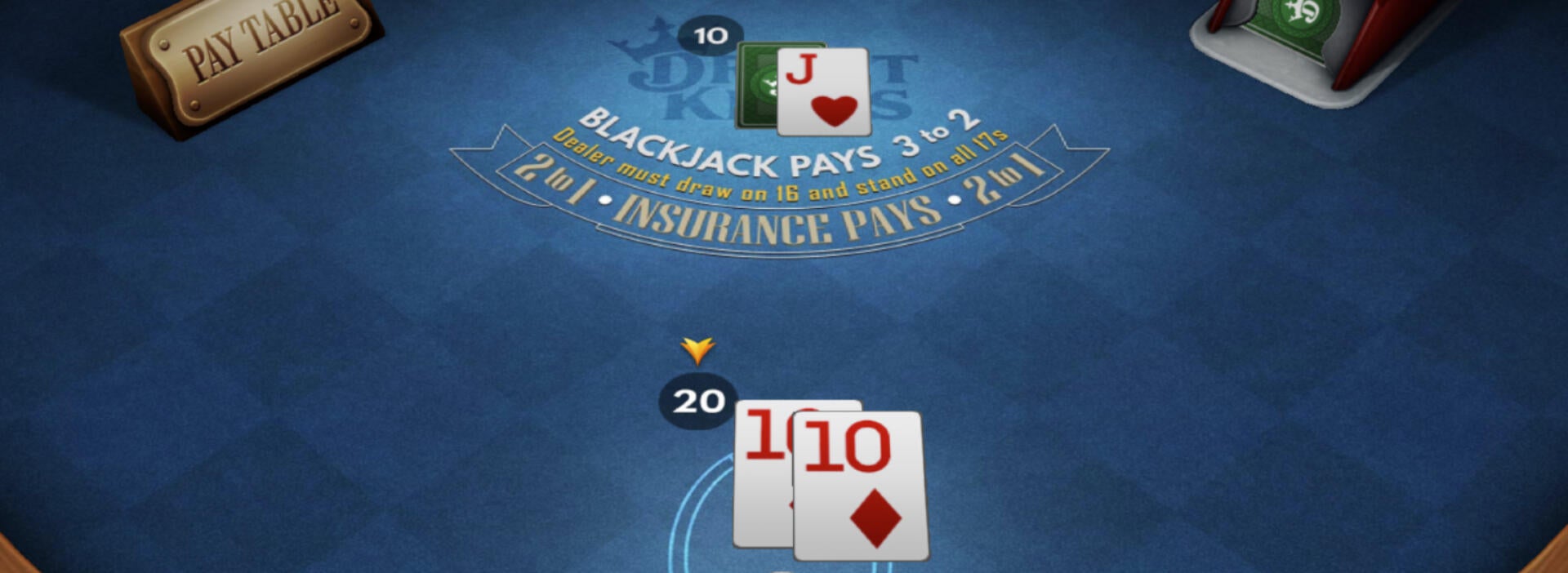
Should you split 10s in blackjack? Online blackjack is one of the most popular and easiest games to learn and play, and a strong strategy can pay dividends. One misconception, though, is the split 10s blackjack idea, believing that by doing so, players can build two strong hands rather than a single one. Don't be confused, though: splitting 10s in blackjack (or face cards) is a poor strategy. Here's why.
Should you split 10s in blackjack? Basic strategy says never.
The rationale behind users wanting to split card values of 10 makes sense on the surface. Players would obviously rather have two winning hands as opposed to a single strong hand. But do you split 10s in blackjack? Short answer: Rarely – if ever.
In reality, a hand of 20 is obviously one of the best in the game, with only one possible hand beating it. The blackjack odds of receiving two cards valued at 10 are already slim. By splitting those cards, players take one strong hand and create two potentially weaker ones while also paying more as they need to match their original stake in order to make that second hand.
Bottom line: By splitting 10s in blackjack, players double their risk in the game while likely lowering their chances of winning the game.
Split 10s blackjack expected value: standing on 20 vs. splitting against a dealer 5 or 6
As it has been and will continue to be emphasized, a 20 is one of the best online blackjack hands available. In fact, that total is as close to a guarantee as they come in the game, with an approximate win rate of 80% to 86%.
Oftentimes, when playing digital or live dealer blackjack games, users may see the dealer's up card as a 5 or 6 and be even more tempted to split 10s. After all, the logic goes, players potentially have more chances to win without obviously knowing the hole card, which is face down.
Still, though, the win probability lowers significantly by splitting rather than standing on 20. By splitting 10s, users decrease their win probability from around 80% to 60% per split hand.
Yes, that is still better than most, but the total expected value also goes down from around +0.7 units to a combined +0.5 for split hands.
Why professionals sometimes split 10s (but why you shouldn't)
This is not to say that even the more experienced players never split 10s. But that doesn't mean the casual user should when playing blackjack, considered the best odds casino game for online casino players.
Professionals, after all, may use card-counting techniques to gain a better understanding of what values are coming up in the deck. That, of course, is not a viable option when playing blackjack at online casinos, which use random number generators to determine the outcome.
Pros may also split 10s if they are in a blackjack tournament and need to maximize their chips.
But those are advanced players in unique situations that don't truly apply to online blackjack. As such, casual players should not follow this route and choose to stand on 20 rather than splitting 10s.
Common scenarios where players are tempted to split – but shouldn't
Many casual users split 10s when they see a weak up card in front of the dealer, like a 4, 5 or 6. As noted, players then believe they have a strong chance of creating two good hands and doubling their winnings. Again, though, the expected value decreases when users split 10s.
Another instance is if a player has suffered several consecutive losing hands. Looking to chase those losses and quickly build back their bankroll, users might split 10s as a high-risk, high-reward gamble.
Chasing losses is never a wise decision, as players should play smarter rather than with more aggression.
The only time splitting 10s makes sense
The rationale behind splitting 10s is relatively acceptable only in the scenario that the dealer has a weak up card, like a 4, 5 or 6.
If players don't bust on either hand, dealers are required to continue taking cards until they reach at least a value of 17. The likelihood of the dealer busting would seemingly be higher in this setting.
Again, though, there is no guarantee that the dealer will do that – especially if you are sitting on the second-strongest hand in the game of 20.
So, ask yourself the question again of when to split 10s. The answer: Never.