Content on this page may include affiliate links. If you click and sign up/place a wager, we may receive compensation at no cost to you.
Dana White urges President Trump to reverse limit on gambling loss deductions
The UFC's Dana White is asking President Trump to change a new law that could see American casino and sports gamblers pay taxes even if they lose money in the year

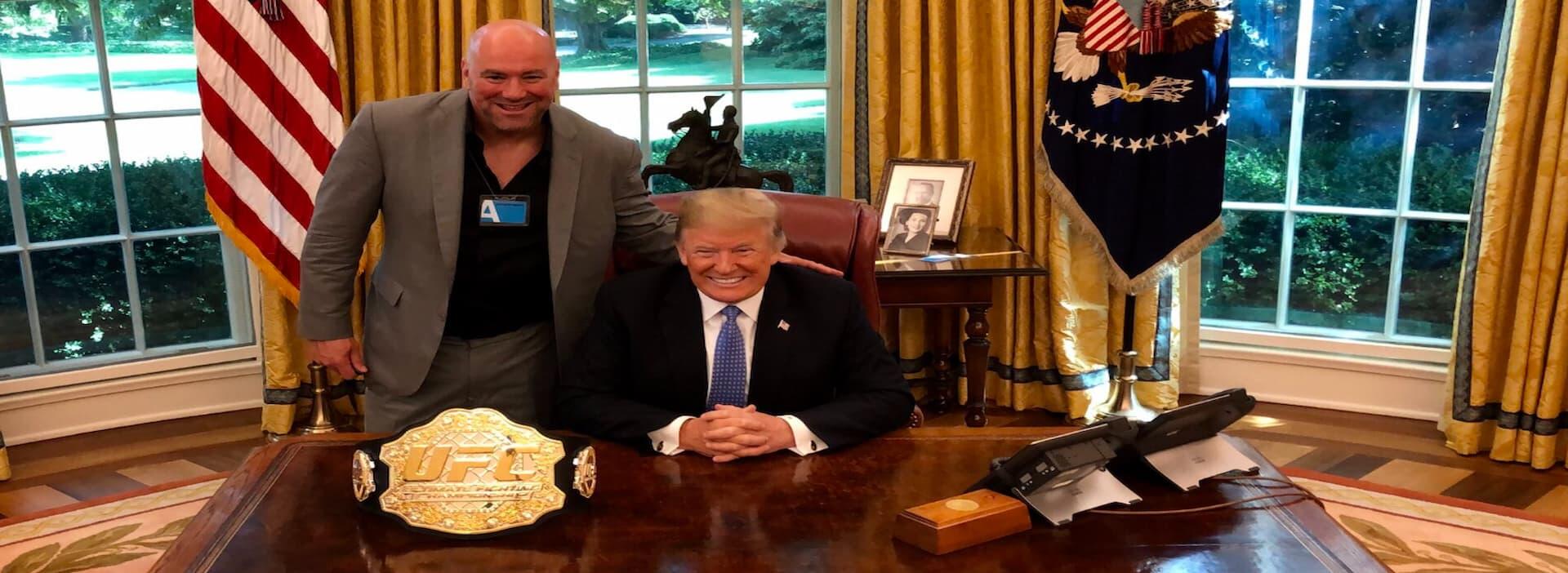
UFC President and CEO Dana White has taken exception to a 2026 gambling tax deduction change. He recently sent a letter to US President Donald Trump, asking for a reversal on a new rule under which American gamblers can only deduct 90% of losses. His plea lines up with a push by the House and Ways Committee to change the law, which is part of the One Big Beautiful Bill Act (OBBBA).
White says losing gamblers could still be liable for taxes
Gambling is an issue close to White because many UFC events take place in Las Vegas. Additionally, the UFC draws worldwide fanfare from those who bet on fights.Â
This motivated White to send a letter to Trump, asking that the POTUS help reverse the 90% limit on gambling loss deductions.
"I write today to raise an issue we have discussed in the past: the need to reverse the 90 percent limit on gambling loss deductions for US taxpayers included in the OBBBA," writes White.
He points out that the change could discourage Americans from engaging in real money online casino play and sports betting.
"The current law makes it irrational to bet in the United States because you could end up owing taxes even when you lose or having a tax bill that exceeds your winnings for the year."
How does the new gambling deductions law work?
The law White references is Section 70144 of the OBBBA, which states:
For purposes of losses from wagering transactions, the amount allowed as a deduction for any taxable year—
"(A) shall be equal to 90 percent of the amount of such losses during such taxable year, and
"(B) shall be allowed only to the extent of the gains from such transactions during such taxable year.
US gambling tax laws still require you to report winnings even in the case of a losing year. However, the key change is that only 90% of deductions can be counted against wins.
Here's an example to illustrate how this law could result in gamblers being taxed into a losing year:
- A gambler plays online slots for real money on and off throughout the year.
- They win $50,000.
- Their losses are also $50,000.
- 50,000 x 0.9 = $45,000 in loss deductions
- 50,000 - 45,000 = $5,000 in taxable gambling winnings
Here's an example to explain excerpt "B" from the referenced law:
- A player wins $50,000 on the year.
- Their losses are $100,000.
- 100,000 x 0.9 = $90,000 in deductions
- Deductions capped at $50,000.
- No 90% rule applies here.
This excerpt ensures that gamblers don't pay taxes on heavy losses. It also prevents the government from having to issue refunds for big gambling losses, just like before the OBBBA.
What the new law means for online casino players
In the past, you didn't have to worry about paying taxes on break-even or losing gambling years. But the 90% rule means that you could still be liable for online casino taxes in certain scenarios.
As shown in a previous example, $50,000 in winnings and $45,000 in losses would be considered $5,000 in taxable income.
The idea here is to raise more federal tax revenue rather than punishing gamblers for exploiting tax loopholes. The concept of sin taxes also comes into play here. But as White points out, it seems unreasonable to expect casino players and sports bettors to potentially cover taxes on losing years.
The House and Ways Committee is currently working to reverse the 90% deduction limit. This would make it more appealing to continue using the BetMGM Casino app and other gaming apps.
Speaking of which, you can currently get up to $2,500 in casino credits and 100 bonus spins by signing up at BetMGM Casino with the promo code SPORTSLINE2500:
Responsible gambling
Legal US online casinos promote responsible gaming by offering options to limit deposits, wagers, session times, and logins. They also provide a self-exclusion option so players can block access to their casino accounts for months or years.
