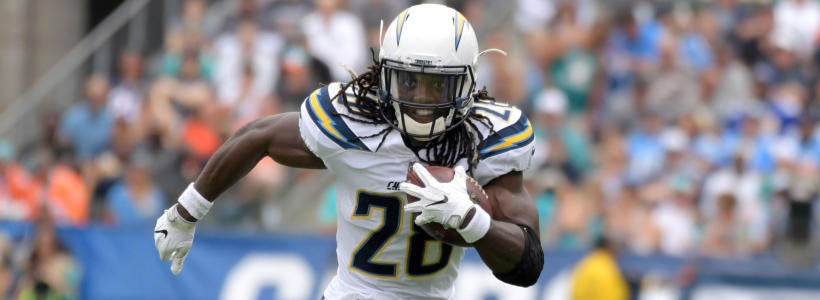
Melvin Gordon was just 14th in Fantasy points per game among running backs last year, but he finished as a top-five RB in points per game for each of the three years prior. Where should he be in your 2020 Fantasy football rankings, and what Melvin Gordon Fantasy football outlook can you expect?
For the first time in his career, Gordon will play for a team other than the Chargers. Historically, the Broncos don't have the track record of excellent RB usage that the Chargers boasted -- especially in the passing game. Gordon's Fantasy value was never based on extraordinary individual play, but rather his heavy involvement near the goal line and in the passing game. Without a team that maximizes those parts of his game, how far should we expect Gordon's production to fall off? His days of regular top-five Fantasy finishes are almost certainly over, but Gordon is being drafted as just the RB17 on average heading into 2020, so he could still return value at a diminished price tag.
The 2020 Melvin Gordon Fantasy football value remains strong, as he's set for another near double digit touchdown campaign. He's an early-round candidate in most formats, but how high should he be in your 2020 Fantasy football rankings? Here's what you need to know:
So which players are poised for breakouts, which sleepers do you need to jump on, and which busts should you avoid at all costs in your Fantasy football league? Join SportsLine now to get early 2020 Fantasy football rankings, plus see which WR is going to come out of nowhere to crack the top 10, all from the model that out-performed experts big time last season.
Melvin Gordon Fantasy ADP & ranking (via SportsLine's projection model)
No. 29.8 ADP
No. 13 RB (non-PPR)
No. 17 RB (PPR)
Melvin Gordon Fantasy projections (via SportsLine's projection model)
168 rushing attempts, 721 yards, 7.7 touchdowns, 58.2 targets, 42.8 receptions, 292 receiving yards, 1.6 receiving TDS
154.9 Fantasy points (non-PPR); 197.7 (PPR)
Melvin Gordon 2020 Fantasy outlook
When projecting Denver's offense, I find their skill position group to be one of the most overrated for Fantasy as a whole. Unless Drew Lock takes an unforeseen step forward in 2020, I don't see how Melvin Gordon, Courtland Sutton, Noah Fant, or Jerry Jeudy can return value on their average draft position. It's not often that every primary skill position player in an offense projects as a poor value at their ADP, but that is currently the case with the pieces of Denver's offense.
Specifically for Gordon, he projects for a decrease in usage from what we saw during the 2016-18 seasons, even as Denver's unquestioned lead back. During those three seasons, Gordon scored 25 rushing touchdowns from within the red zone. He ranked fourth in red zone carries in 2016 and third in 2017. Gordon averaged over 50 red zone carries during that time. For reference, Denver hasn't had a running back top 30 red zone rushes in a single season over that time. In just 12 games last season, Gordon saw more carries from within the five-yard line (15) than Denver's entire backfield combined. In total, L.A.'s backs combined for 80 red zone opportunities (carries and targets) while Denver combined for 63.
The Broncos don't pass to their backs at nearly the rate L.A. does, either. Over the past three years, the Chargers have averaged 135.3 targets -- which is boosted by the emergence of Austin Ekeler -- to their running backs. Meanwhile, Denver has averaged just 100.7 RB targets. The Broncos haven't had a running back top even 50 targets in a season since 2013, and the position group's target share fell in the five games Drew Lock started last year.
If Gordon is looking at fewer targets and scoring opportunities, the only way to salvage his sinking Fantasy value is to do something he's done just once in his five-year career -- be an efficient rusher. Gordon has averaged below four yards per carry in every season but his 12-game 2018, which was also the only year he recorded a PFF rushing grade higher than 71.7. In 2019, Gordon ranked 28th among 61 qualified rushers in PFF's rushing grade, and he came in just 40th in elusiveness rating.
Unless Gordon ends up ceding more work to Phillip Lindsay than expected, the downside isn't as low as some of the backs being drafted around him. He has what appears to be a surefire role and is more likely to play a three-down role than most backs being selected outside of the top-12. However, Denver's offense limits Gordon's upside and projections don't point towards him being a value at his ADP. I'd much rather take a chance on James Conner, Todd Gurley, or David Johnson if drafting a back in the third-round.